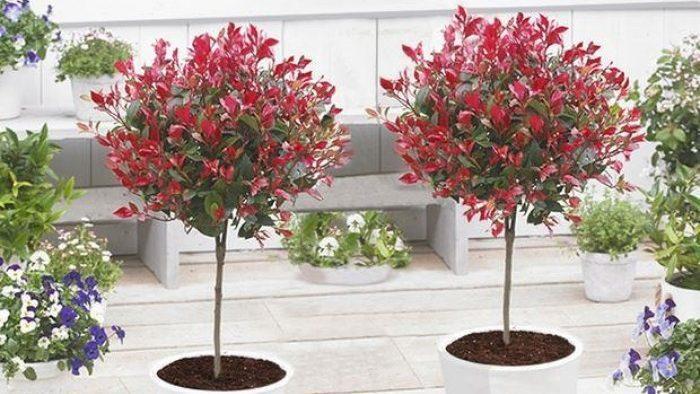
Photinias are small trees or shrubs. There are a number of species, some of which are evergreen while others are deciduous. In late spring or early summer, they produce small white clusters of flowers, which are followed by red berries. P. x fraseri ‘Red Robin,’ an evergreen shrub known for its vivid red young leaves, the most commonly grown photinia.
How to choose the right photinias for you
There are a number of different species to choose from, all of which provide vibrant seasonal foliage displays. This includes clusters of tiny white flowers and red berries. They can be grown as specimen trees or shrubs, hedges, or wall shrubs. They go well with a variety of garden styles—formal or informal, large or small.
Some species cannot thrive in chalky or alkaline soil because they require neutral or acidic conditions. If your soil isn’t suitable, you can grow them in large containers as well. Check out our guide on understanding the pH of the soil. Some photinias can grow very large—up to 5 meters (15 feet) in 10 years—so make sure you know how big they will grow before you buy one. Be prepared to prune annually or give larger species ample space.
Varieties of photinia
There is a huge variety of photinias, each with their own characteristics and traits. Depending on the type of shrub you are looking to add to your garden, there will surely be a photinia for you. Some of the most loved varieties of photinia are:
Red Robin: The ‘Red Robin’ is an evergreen shrub known for its gorgeous red-tipped leaves. Its glossy green, fresh red leaves add interest all year long. It’s perfect for hedging or as a standalone feature plant.
The ‘Red Robin’ is also available in several sub-varieties. The ‘Little Red Robin’ is a more compact version, perfect for pots and borders. The ‘Carre Rouge’ variety is a modern version with stronger and more compact growth. The ‘Chico’ variety is a dwarf version, with a rounded form. The ‘Robusta’ variety grows significantly taller than ‘Red Robin,’ reaching a mature height of about 5–6 meters. It also grows more quickly, becoming more lanky and sparse.
Pink Crispy: The ‘Pink Crispy’ variety of photinia has marbled green foliage, with new growth emerging a stunning pink colour. It is a truly unique addition to your borders or even planted as stunningly bright hedges.
Pink Marble: This variety of photinia has a striking blend of green and white variegated leaves with delightful pink flushes on new growth. It’s perfect for mixed borders, in a pot, or even grown as hedging.
Planting your photinias
Photinias thrive in moist, well-drained soil that is rich and fertile. As long as you add plenty of well-rotted garden compost or manure prior to planting, they will tolerate the majority of soil types, including clay. Find out what kind of soil you have by reading our guide. The majority of species thrive in conditions ranging from neutral to acidic, but Photinia beauverdiana and P. villosa in particular struggle to thrive in chalky soil.
Photinias like full sun or partial shade, but full sun usually produces the best flowers and leaves. They also like to be in a sheltered position. If grown in an exposed location, the young shoots may become scorched by late frosts, dry winds, or both. Photinias can be grown as wall shrubs in colder climates, where they thrive in additional warmth and shelter. Photinia fraseri ‘Red Robin,’ in particular, is frequently utilised as a hedge, but they can also be grown in large containers and planted in borders or as stand-alone specimens.
Planting in the ground
The best time to plant photinias is from autumn to spring, when the ground isn’t frozen or wet. However, as long as the soil around the roots is kept moist, they can be planted at other times of the year.
Planting photinias is simple, and they should settle in well and survive for a long time. Photinias are typically grown in the ground, but P. fraseri cultivars, in particular, can be grown in containers provided that they are pruned to maintain their compact shape.
To plant in the ground, take plants out of their containers, trim the roots that are stuck in the pot, and spread the roots of bare-root plants to get an idea of how far they have spread. Make a planting hole that is at least three times the diameter of the root system, but no deeper than the roots.
Before planting, use a fork to break up the compacted soil on the sides of the planting hole. Before removing the plants from their containers, give them plenty of water.
Place it in the planting hole and position it so that the first flare of roots are level with the surface of the soil. To reveal the flare of the roots, container-grown plants may require the top layers of compost to be scraped away.
Fill the planting hole carefully, removing air pockets by placing soil between and around all of the roots. Firm the soil gently, avoiding compacting the soil into a hard mass and water in.
Ongoing care
Photinias are low-maintenance plants that, once established, should take care of themselves.
At least for the first two years after planting, water frequently. They shouldn’t need any more water once they’re established, unless it’s particularly hot and dry. Photinia may require regular watering when grown as a wall shrub if it is protected from rain. During the summer, plants in containers should be watered frequently because they can dry out quickly.
Photinias generally do not require additional feeding, with the exception of when the soil is poor or when they want to grow more. In the spring, apply the recommended dose of a general-purpose fertiliser to the surrounding soil if you wish to add additional nutrients to the soil. Because most composts run out of nutrients after a few months, plants in containers need to be fed frequently. Check out our maintenance guide for containers.
Around the base, a thick layer of mulch—such as well-rotted garden compost or manure—will assist in weed suppression and soil moisture retention. Use it in the spring or autumn when the ground is damp. To prevent the bark from rotting, leave a gap of 10 centimeters (4 inches) around the stem.
Frequently asked questions
“Photinias only need to be pruned once or twice a year in the spring or summer to keep their overall shape and encourage dense growth. Pruning can be done more frequently on vigorous species to keep them within limits,” says Chris Bonnett, a gardening expert for The Express.
Two of the most popular types in the Photinia family are the ‘Robusta’ and the ‘Red Robin.’ Because they have so many traits in common, it can sometimes be difficult to distinguish between them. The growth style and ultimate height of the two varieties are the easiest ways to tell them apart.
The Photinia ‘Red Robin’ is a slower-growing plant with fewer “leggy” branches and a more compact form and shape. When fully grown, it reaches a height of around 3–4 meters.
Photinia ‘Robusta’ grows significantly taller than ‘Red Robin,’ reaching a mature height of about 5–6 meters. It also grows more quickly, becoming more lanky and sparse.
The choice between these popular types ultimately boils down to whether you like a taller privacy hedge or one that is more compact and smaller.
Shop now